
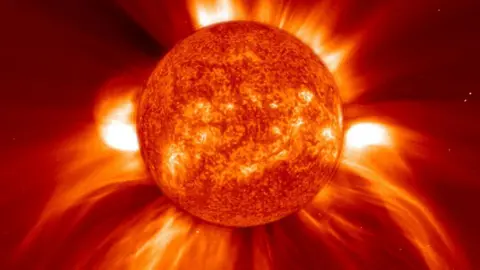
For India's first solar observatory, 2026 is expected to be truly unique.
This marks the initial occasion the spacecraft – that entered in orbit recently – will be able to watch the Sun during the peak of its solar cycle.
As per research, this occurs approximately every 11 years when the Sun's polarity reverses – a similar Earth scenario could be the planet's poles swapping positions.
This period of great turbulence. It sees the Sun changing from calm to stormy and is marked by a huge increase in the frequency of solar eruptions and massive solar flares – enormous clouds of fire that blow out from the solar corona.
Made up of ionized particles, a coronal mass ejection may have a mass up to a trillion kilograms and can attain velocities of up to 3,000km per second. It can head out in any direction, even toward our planet. At top speed, the journey takes an ejection 15 hours to cover the 150 million km Earth-Sun distance.
"During typical or quiet periods, our star launches two to three CMEs a day," says a leading scientist. "Next year, we expect them to be 10 or more each day."
Researching CMEs is one of the key research goals for the Indian maiden solar mission. Firstly, because the ejections provide an opportunity to learn about the star at the centre of our planetary system, and two, since events occurring on the solar surface threaten systems on our planet and in space.

Impacts on Our Planet and Orbital Systems
CMEs rarely pose immediate danger to human life, but they do affect our planet by causing geomagnetic storms that impact conditions in Earth's vicinity, where nearly 11,000 satellites, comprising Indian satellites, are stationed.
"The most beautiful displays of a CME include northern lights, being a clear example that solar particles from our star journey to Earth," the expert explains.
"However, they may cause electronic systems aboard spacecraft fail, disable electrical networks and disrupt weather and communication satellites."
Historical Solar Events
- The strongest solar event in history occurred during the 1859 solar superstorm that disabled telegraph lines worldwide
- During 1989, sections of Canadian electrical network failed, affecting millions in darkness for hours
- In November 2015, solar activity disrupted flight operations, causing disruption in Sweden and some other European airports
- In February 2022, an ejection caused 38 commercial satellites being lost
If we are able to observe events on the Sun's corona and detect solar activity or a coronal mass ejection as it happens, measure its heat at origin and watch its path, it can work as advanced warning to shut down power grids and spacecraft and move them out of harm's way.
The Mission's Special Capability
There are other space observatories observing the Sun, India's spacecraft has an advantage compared to rivals when it comes to studying the solar atmosphere.
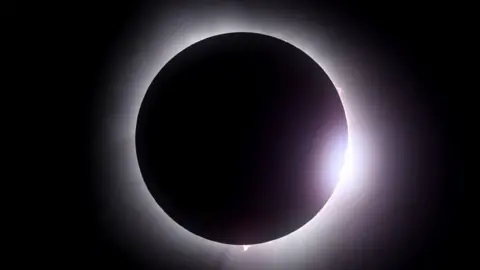
"The instrument has perfect dimensions that lets it effectively simulate the Moon, completely blocking the Sun's photosphere permitting continuous observation of nearly the entire solar atmosphere around the clock, throughout the year, including during solar events," says the expert.
Essentially, this instrument functions as an artificial Moon, blocking the solar glare allowing researchers continuously observe the dim solar atmosphere – something the real Moon does only during eclipses.
Moreover, this is the only mission that can study solar events in visible light, enabling it to measure eruption heat and thermal output – crucial data that show how strong a CME would be if it headed toward Earth.
Preparation for Peak Period
To prepare for the upcoming peak solar activity period, researchers collaborated to study information obtained from one of the largest CMEs that Aditya-L1 has observed recently.
This event began on 13 September 2024 during early hours. Its mass was 270 million tonnes – the iceberg that struck the ship weighed much less.
Initially, the heat was 1.8 million degrees Celsius and the energy content comparable to 2.2 million megatons of explosives – in comparison nuclear weapons on Hiroshima and Nagasaki were 15 kilotons and 21 kilotons each.
Although these figures seem massive, the expert classifies it as a moderate event.
The space rock that eliminated the dinosaurs on our planet was 100 million megatons and when solar peak occurs, there may be CMEs carrying power equal to even more than that.
"In my view the CME we evaluated to have occurred during periods of typical solar activity. Now this sets the benchmark that we'll be using to evaluate what to expect when the maximum activity cycle occurs," he states.
"The learnings from this will help us work out the countermeasures to be adopted to protect satellites in near space. Additionally, they'll aid achieving a better understanding of our space environment," he adds.


